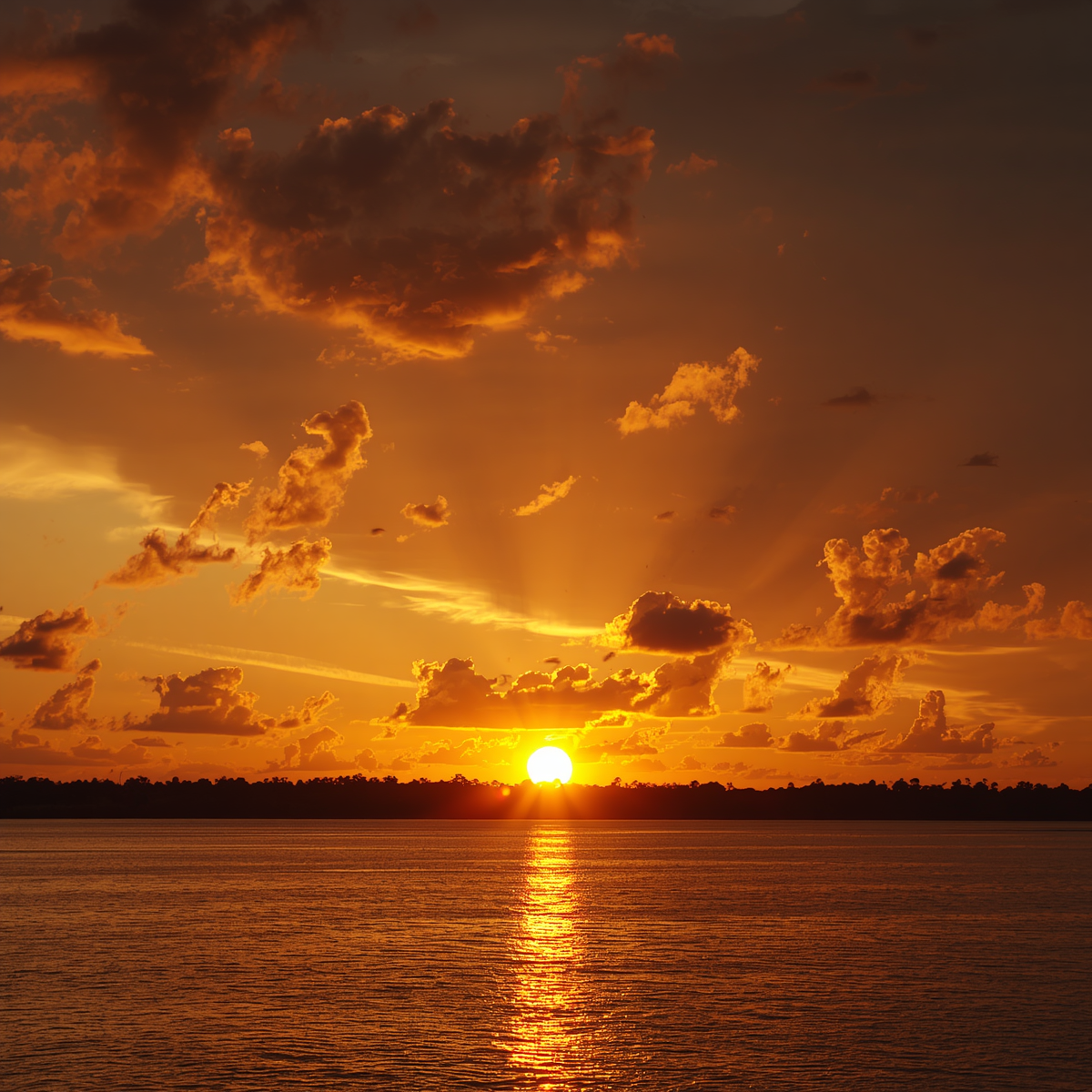
There are sunsets. And then there are Armstrong Beach sunsets.
Anyone who has stood on the foreshore at Armstrong Beach as the day ends will tell you the same thing: you don't just watch it — you feel it. The sky doesn't simply change colour. It transforms, stage by stage, from the pale gold of late afternoon into something that defies easy description. Liquid copper. Molten amber. A sky on fire above still water that mirrors every shade back at you doubled.
We've been watching these skies for years. And what we've come to understand is that no two are the same — and that the season shapes the show in ways worth knowing before you arrive. This is your guide to the Armstrong Beach sunset, season by season.
Why Armstrong Beach Sunsets
Are Different
Position matters. Armstrong Beach allows for incredible western views down from the Pioneer Valley and the broad coastal plain stretching toward the Sarina hinterland. The mountains to the west provide a pan contrast of filtered sunrays, no high-rise development to interrupt the horizon. The sky here is enormous — the kind of sky that city dwellers have genuinely forgotten exists.
The tropical latitude amplifies everything. At 21 degrees south, the sun takes a shallower descent path than it does further south, which means the golden hour at Armstrong Beach is often ninety minutes or more of continuously shifting, deepening colour. The atmosphere at this latitude carries moisture and fine coastal particles that scatter light in ways that produce colours a southern photographer would struggle to believe.
Add the tidal flats. At low tide, the shallow water and exposed sand create a vast reflective surface that effectively doubles the sky — you are surrounded above and below by the same burning colours. It is, quite simply, one of the most visually spectacular natural settings in Queensland.
"I've photographed sunsets on five continents. The evening I spent on the Armstrong Beach foreshore in March was in the top three of my life. The water reflection, the cloud structure, the colour range — it was extraordinary."
Summer: December to February
The verdict: Dramatic, electric, occasionally wild.
Summer at Armstrong Beach is the season of the build-up. The air carries the charge of approaching storms — and it is this atmospheric electricity that produces the most dramatic sunsets of the year. As the afternoon heat peaks and the sea breeze shifts, towering cumulus clouds develop to the northwest. By late afternoon, these cloud structures — some reaching 40,000 feet — catch the low sun and ignite.
The colours in a summer sunset here are not subtle. They are violent: deep crimson at the cloud bases, electric orange through the mid-levels, and above it all an improbable deep violet fading to indigo at the zenith. On the evenings when a storm cell sits on the horizon without breaking overhead, you have a front-row seat to one of nature's most spectacular light shows — lightning illuminating the cloud interiors while the exterior burns amber and red from the setting sun.
Summer Sunset Guide
- Sunset time: 6:30–6:45 pm AEST
- Best viewing: Foreshore west of the boat ramp — arrive by 6:00 pm
- What to expect: Violent crimsons, electric orange, deep violet above — the most dramatic palette of the year
- Bonus: Storm-season lightning within cloud structures while exterior burns sunset gold
- What to bring: Light clothing, cold drink, wide-angle lens if you photograph
Autumn: March to May
The verdict: The golden standard. Peak sunset season.
If you visit Armstrong Beach for one sunset, make it autumn.
The storm season has softened. The humidity is easing. The sky carries a clarity that summer doesn't offer, but the atmosphere still holds enough moisture to produce colour saturation that the drier months cannot match. Autumn sunsets at Armstrong Beach are the ones that end up on screens, in frames, and in the memories of people who came for a weekend and stayed considerably longer.
March and April are the peak months. The sun sets between 6:00 and 6:30 pm — late enough to enjoy the afternoon, early enough to catch the full colour sequence. The cloud formations are gentler than summer — long bands of altocumulus rather than towering cumulonimbus — and these horizontal structures catch and hold colour in ways that produce the copper-and-gold palettes Armstrong Beach is famous for.
"We came for the long weekend in April. We went home six weeks later. The sunsets had something to do with it." — Owner, Turquoise Waters Estate, Stage 1
The tidal flats in autumn are particularly extraordinary. The combination of calm conditions, clear air, and the low sun angle creates water reflections that appear almost computer-generated in their perfection.
Autumn Sunset Guide
- Sunset time: 5:50–6:30 pm AEST
- Best viewing: Walk south along the foreshore — tidal flat reflection is best at the waterline at low tide
- What to expect: Warm copper, deep gold, soft amber — the most photogenic palette of the year
- Pro tip: Check the tide chart — low tide within two hours of sunset produces the best reflections
- What to bring: Camera, blanket for the sand, something to mark the moment with
Winter: June to August
The verdict: Cool, crisp, and quietly breathtaking.
Winter in North Queensland is not what the word implies for most Australians. At Armstrong Beach, June through August brings days of 22–26 degrees, virtually no humidity, and skies of a blue so deep and clear that the daytime itself is worth remarking on.
The winter sunset is a different experience — quieter, more refined, less theatrical but no less beautiful. Without the atmospheric moisture of the wet season, the colour range narrows slightly: the violent crimsons of summer give way to softer golds, warm peaches, and the particular pale orange that sits at the horizon in the last minutes before dark. What winter offers in return is clarity and precision — a photographer's sky.
Winter sunsets are also the most social. The weather is comfortable enough to sit outside for extended periods, and the Armstrong Beach community has a tradition of foreshore gatherings in the cooler months that visitors are warmly welcomed into. There is something quietly wonderful about watching the sky change colour with people who chose to live here precisely because of evenings like this.
Winter Sunset Guide
- Sunset time: 5:25–5:50 pm AEST — arrive by 5:00 pm for the full sequence
- Best viewing: The picnic area at the northern end of the foreshore — fire pits often in use
- What to expect: Soft golds, warm peaches, precise colour gradients — refined rather than dramatic
- Bonus: Humpback whale migration visible offshore June–October — possible whale sightings at sunset
- What to bring: A light jacket for after dark, a camp chair, good company
Spring: September to November
The verdict: The warm-up act. Building toward something special.
Spring is the season of anticipation at Armstrong Beach. The days are lengthening, the temperature climbing back through the high twenties, and the first of the pre-wet-season humidity beginning to return. The sunsets reflect this: warming up, becoming more saturated, more energetic — as if the sky itself knows what is coming.
September and October produce some of the year's most underrated sunsets. The combination of increasing humidity and still-clear skies creates colour depth that the cool winter months don't quite achieve. The golds are warmer, the oranges more intense, and on the evenings when the first season clouds appear on the horizon, you get a preview of what summer will deliver.
November brings the build-up in earnest. The sunsets become charged again — electric in a way that is visceral and unmistakeable. The sky building toward the drama of the storm season, the colours deepening, the atmosphere thickening with the promise of what is to come.
Spring Sunset Guide
- Sunset time: 5:50–6:30 pm AEST
- Best viewing: Anywhere on the foreshore — in spring the whole western horizon is the view
- What to expect: Intensifying golds and oranges building toward summer's drama
- November bonus: First electric build-up evenings of the season — a preview of summer's best
The Armstrong Beach
Sunset Ritual
The residents of Armstrong Beach have, over time, developed something that can only be described as a sunset ritual. It is informal, unorganised, and entirely natural — which is precisely what makes it special.
In the late afternoon, particularly in the cooler months, people begin to drift toward the foreshore. It happens without coordination. A couple with a dog. A family with children who have learned to be quiet at the right moment. Someone with a camp chair and a cold drink who has clearly done this hundreds of times. And increasingly, people who have driven from Sarina or even from Mackay specifically for the evening sky.
This is what a community that has access to something genuinely extraordinary looks like. Not a tourist attraction. Not a scheduled event. Just people who know what is about to happen, gathering to watch it together.
When you live at Turquoise Waters Estate, this is your Tuesday evening.
Plan Your Visit
Armstrong Beach is approximately 45 minutes south of Mackay CBD via the Bruce Highway and Sarina. The foreshore is publicly accessible with parking at the main beach access point.
Tide tables for Armstrong Beach are available from the Bureau of Meteorology. Low tide within two hours of sunset produces the best tidal flat reflections — this combination is worth planning around.
If an Armstrong Beach sunset is the experience that convinces you this is where you want to be — we would encourage you to act on that instinct. The 47 lots at Turquoise Waters Estate are releasing in stages and Stage 1 is now available. Register your interest today.
Some places you visit. Some places you stay. Armstrong Beach tends to be the latter.